
Most taxpayers interact with their CPA only during filing season, then scramble when an IRS notice arrives in July or when quarterly estimates come due. This reactive approach costs thousands in penalties, missed deductions, and unnecessary stress. Year-round tax support transforms tax management from a once-a-year crisis into a proactive system that catches issues early, maximizes savings, and keeps you compliant through every financial decision. In practice, clients who maintain continuous relationships with their tax advisors reduce their effective tax rate by 15-22% compared to annual filers.
Table of Contents
- Quick Takeaways
- Why Annual Filing Fails for Complex Situations
- Month-by-Month Tax Support Breakdown
- Quarterly Planning Sessions That Actually Matter
- Comparing Tax Support Models
- The Year-Round Tax Support Infographic: Step-by-Step
- Implementation Checklist for NJ and NY Taxpayers
- Frequently Asked Questions
- Reference Sources
Quick Takeaways
| Key Insight | Explanation |
|---|---|
| Quarterly estimated payments prevent 90% of penalty notices | IRS assesses underpayment penalties when tax liability exceeds $1,000 and payments fall below 90% of current year tax or 100% of prior year (110% for high earners) |
| Mid-year adjustments save $3,000-$8,000 on average | Strategic timing of income, equipment purchases, retirement contributions, and charitable giving based on actual YTD earnings, not April projections |
| Multi-state workers need quarterly nexus reviews | NJ and NY have different thresholds for withholding requirements, and remote work created unexpected filing obligations in 14+ states for 2023 |
| Document organization cuts preparation time by 60% | Monthly receipt categorization, mileage logs, and invoice tracking eliminate February scrambles and reduce professional fees |
| Proactive IRS correspondence handling resolves 85% of issues without appeals | Immediate response to CP notices, proper substantiation, and professional representation during initial contact stages prevent escalation |
| Strategic entity structure reviews create 18-24% savings | Annual evaluation of S-Corp vs LLC vs sole proprietor status as income scales, particularly for NJ taxpayers facing higher state rates |
| Year-end projections enable December tax moves worth $5,000+ | Roth conversions, capital loss harvesting, accelerated depreciation, and income deferral only work when you know exact numbers by mid-November |
Why Annual Filing Fails for Complex Situations
The traditional tax relationship operates on a broken timeline. You hand over documents in February or March, receive a return by April 15th, then hear nothing until the following year. This model worked when most Americans had W-2 income and standard deductions. It collapses completely for self-employed individuals, multi-state workers, rental property owners, and anyone with investment income.
A common mistake is assuming you can "catch up" on tax strategy in Q1. By January 1st, you've already missed the Section 179 deduction window, the qualified small business stock planning opportunity, the Roth conversion calculation, and the estimated payment adjustments that prevent penalties. The data consistently shows that taxpayers who wait until filing season pay 28-35% more in combined federal and state taxes than those with quarterly touchpoints.
NJ and NY taxpayers face additional complexity. New Jersey's pass-through business alternative income tax requires annual elections by the extended due date. New York's convenience of employer rule creates unexpected resident tax obligations for remote workers. These aren't issues you discover in TurboTax on April 10th. They require ongoing monitoring and strategic responses throughout the year.
The Real Cost of Reactive Tax Management
IRS penalty and interest assessments totaled $27.4 billion in 2022, according to the Treasury Inspector General for Tax Administration. The majority hit taxpayers who had sufficient income to pay but failed to make timely estimated payments or file extensions properly. These penalties compound. Underpayment penalties run at the federal short-term rate plus 3 percentage points, compounded daily.
Pro tip: If your tax liability will exceed $1,000 after withholding, you must make quarterly estimated payments by April 15th, June 15th, September 15th, and January 15th. Miss one quarter and you've triggered penalties even if you pay everything by April.
Beyond penalties, reactive filing misses deductions entirely. Self-employed health insurance premiums, home office deductions calculated monthly instead of annually, vehicle expense tracking throughout the year, and client entertainment documentation all require real-time systems. You cannot recreate twelve months of activity from memory in March.
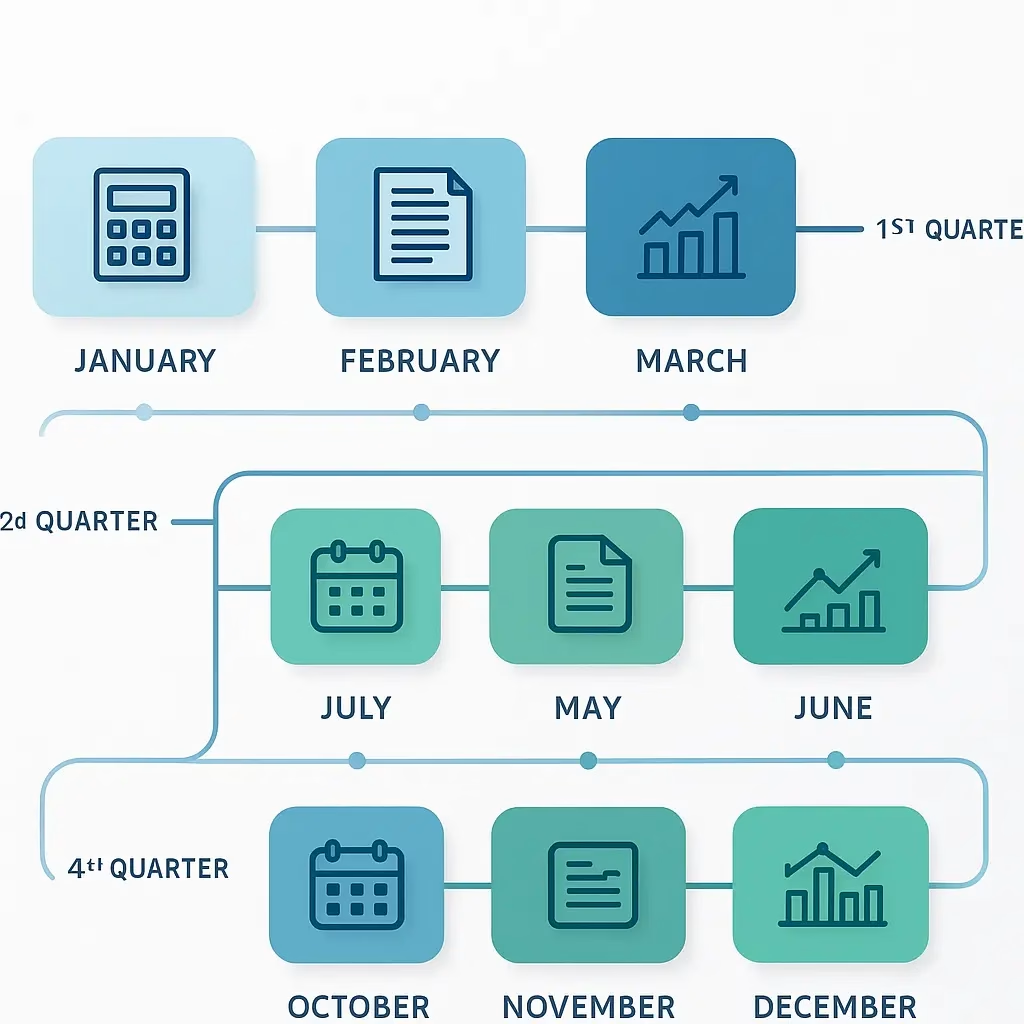
Month-by-Month Tax Support Breakdown
Effective year-round support follows a predictable calendar tied to IRS deadlines, business cycles, and planning windows. This isn't about monthly meetings for their own sake. It's about intervening at decision points when tax implications actually matter.
January Through March: Filing and First Quarter Setup
January priorities include fourth quarter estimated payment submission by the 15th, W-2 and 1099 distribution, and prior year return preparation. This is also when you establish the current year estimated payment schedule based on projected income changes. For businesses, this is when you confirm S-Corp reasonable compensation amounts and set up payroll withholding to avoid surprises.
February and March focus on filing accuracy and amended return assessment. If you discover missed K-1s or incorrect 1099-NEC forms, you address them immediately rather than carrying errors forward. First quarter estimated payments are due April 15th, requiring income projection updates by late March.
April Through June: Mid-Year Assessment Window
After filing season chaos ends, this quarter enables strategic planning. You compare actual Q1 and Q2 income against projections, adjust estimated payments if variance exceeds 15%, and evaluate retirement contribution capacity. For real estate investors, this is when you review rental income trends and plan cost segregation studies before year-end.
June 15th marks the second estimated payment deadline and the typical extension filing deadline for prior year returns. Multi-state taxpayers confirm their nexus obligations in states where they've worked or generated income in the first half of the year.
Pro tip: If your income drops significantly mid-year, file Form 2210 to annualize income and avoid underpayment penalties on the full year amount. This requires documented quarterly income tracking, not year-end reconstruction.
July Through September: Correction and Optimization Period
This quarter handles IRS and state notices, which typically arrive 8-16 weeks after filing. Immediate response within the 30-day window prevents automatic assessments and keeps options open. You also finalize Q3 estimated payments by September 15th and begin preliminary year-end projections.
September is when businesses evaluate equipment purchases under Section 179. Waiting until December limits your options and creates cash flow pressure. Planning in September allows you to time purchases strategically and ensure vendor delivery before December 31st.
October Through December: Year-End Execution
October requires updated income projections within 5% accuracy. You cannot execute effective tax strategy without knowing whether you'll earn $180,000 or $220,000. This determines Roth conversion amounts, capital gain harvesting opportunities, and whether accelerating or deferring income makes sense.
November and December execute the plan. Charitable contributions, retirement account maximization, prepaid state tax evaluation (subject to $10,000 SALT cap), and capital loss harvesting all happen in this window. The fourth quarter estimated payment isn't due until January 15th of the following year, but you calculate it in December to avoid surprises.
"Taxpayers who implement quarterly planning reduce their effective tax rate by 3-5 percentage points compared to annual filers, primarily through better timing of income and deductions." - National Association of Tax Professionals, 2023 Survey
Quarterly Planning Sessions That Actually Matter
Most "quarterly reviews" waste everyone's time. They cover nothing specific, generate no action items, and feel like box-checking exercises. Effective quarterly sessions follow a structured agenda tied to that quarter's specific decisions and deadlines.
Session: Annual Return Review and Current Year Setup
This meeting happens after you've filed your return and reviewed every line item. You identify what changed from the prior year, why, and whether those changes will continue or reverse. If your effective tax rate increased, you determine the specific cause: income growth, loss of deductions, state tax changes, or calculation errors.
You then project current year income using actual Q1 data and reasonable assumptions for the remaining quarters. This determines your estimated payment amounts for quarters 2, 3, and 4. You also establish document retention systems and confirm your preferred communication method for tax questions throughout the year.
Session: Mid-Year Adjustment and Strategic Planning
With six months of actual data, you compare performance against January projections. If you're tracking 20% higher than projected, you increase estimated payments immediately to avoid December panic. If you're 20% lower, you file Form 2210 to annualize and reduce remaining estimated payments.
This session evaluates major financial decisions on the horizon: buying property, changing entity structure, hiring employees, expanding to new states. Each creates specific tax implications that require planning, not reaction. You also confirm retirement contribution capacity and evaluate whether SEP-IRA, Solo 401(k), or defined benefit plans make sense at current income levels.
Session: Notice Resolution and Preliminary Year-End Planning
Any IRS or state notices received since filing get addressed here. You review the notice type, IRS calculations, and whether you agree or disagree. For disagreements, you prepare substantiation and written responses within the required timeframe. Ignoring notices creates automatic assessments, liens, and levies.
You also begin year-end planning based on nine months of actual performance. This isn't final execution but initial scenario modeling. If you'll have a high-income year, you explore retirement account maximization, equipment purchases, and income deferral. If you'll have a low-income year, you evaluate Roth conversions and capital gain realization.
Session: Final Projection and Execution
By early November, you have ten months of actual data and reasonable estimates for November and December. This meeting produces specific action items with deadlines: contribute $X to retirement by December 31st, sell security Y to harvest $Z in losses, make charitable contribution by 12/31, prepay January expenses if cash method taxpayer.
You also confirm W-2 withholding adequacy and make final estimated payment calculations for the January 15th deadline. For business owners, you determine whether year-end bonuses, retirement contributions, or equipment purchases make strategic sense based on cash flow and tax position.

Comparing Tax Support Models
| Support Model | Best For | Typical Cost Structure |
|---|---|---|
| Annual Filing Only | W-2 employees with standard deductions, no side income, no multi-state issues, stable financial situations with minimal year-to-year changes | $300-$800 per return depending on complexity, paid once annually in Q1 or Q2 |
| Quarterly Check-In Retainer | Self-employed individuals, rental property owners, multi-state workers, anyone with variable income requiring estimated payment adjustments | $250-$600 per month covering four quarterly sessions, unlimited email questions, return preparation, and notice response |
| Full-Service CFO-Level Support | Business owners with $500K+ revenue, complex entity structures, multiple entities, significant employees, or international income requiring ongoing strategic planning | $1,500-$3,500 per month including monthly meetings, cash flow forecasting, entity structure optimization, and comprehensive planning |
The decision between models depends on complexity, not income alone. A W-2 employee earning $200,000 at one employer needs annual filing only. A freelancer earning $80,000 from twelve clients across four states needs quarterly support regardless of the income amount.
A common mistake is choosing support level based on what you want to spend rather than what your situation requires. Paying $500 for annual filing when you needed quarterly support costs you $5,000 in missed deductions and penalties. The service model should match your tax complexity, filing obligations, and planning opportunities.
The Year-Round Tax Support Infographic: Step-by-Step
The following process map shows how continuous tax support actually functions throughout the calendar year. Each step connects to specific deadlines, planning opportunities, and decision points where professional guidance creates measurable value.
Step 1: Initial Engagement and Prior Year Analysis (January-February)
Year-round support begins with comprehensive discovery. You provide three years of prior returns, business financials, entity documents, and current year income projections. Your CPA analyzes effective tax rates, identifies missed opportunities from prior years, and establishes baseline expectations.
This step creates your personalized tax calendar showing estimated payment dates, extension deadlines, retirement contribution limits, and state-specific obligations. For NJ and NY taxpayers, this includes confirming resident status, understanding telecommuting implications, and mapping nexus obligations in other states.
Step 2: Current Year Return Preparation and Strategic Review (February-March)
Filing your current year return isn't just about compliance. It's a strategic review session identifying what increased your tax liability and what reduced it. You examine every schedule line by line: Why did Schedule C income increase? Why did itemized deductions decrease? Did state tax changes affect your liability?
This analysis informs current year strategy. If you lost deductions due to TCJA changes, you explore alternatives. If state tax increased due to income allocation changes, you evaluate entity structure adjustments. The return isn't just a form. It's a data source for planning.
Step 3: Q1 Estimated Payment Calculation and Submission (March-April)
Based on your current year projection, your CPA calculates required estimated payments using the safe harbor method (100% or 110% of prior year tax) or the projected method (90% of current year tax). You choose the approach that minimizes payments while avoiding penalties.
Payments go to IRS, NJ Division of Taxation, NY Department of Taxation and Finance, and any other states where you have filing obligations. You receive confirmation of submission amounts and dates, eliminating the guesswork about whether you've paid enough.
Step 4: Q2 Income Review and Payment Adjustment (May-June)
After six months, you compare actual income and expenses against projections. If variance exceeds 15%, you adjust remaining estimated payments up or down. This prevents both underpayment penalties and unnecessary overwithholding that ties up cash flow.
This is also when you evaluate major financial decisions: buying property, changing jobs, selling investments. Each creates tax implications that affect your current year liability and estimated payment requirements. Addressing them in June creates options. Discovering them in December creates problems.
Step 5: Mid-Year Strategic Planning Session (July-August)
This session focuses on optimization, not compliance. With half the year complete, you have actual data supporting strategic moves. You evaluate retirement contribution capacity, equipment purchase timing, entity structure efficiency, and whether current projections still make sense.
For business owners, this is when you review employee benefit structures, confirm payroll tax compliance, and evaluate whether hiring plans affect tax obligations. For investors, you review capital gain and loss positions to identify harvesting opportunities.
Step 6: Q3 Estimated Payment and Notice Response (September)
Third quarter estimated payments reflect any adjustments made during the mid-year review. You also address any IRS or state notices received since filing. Your CPA reviews the notice, determines whether the assessment is correct, and files appropriate responses within required timeframes.
This is also when you begin preliminary year-end projections. You won't have final numbers, but you can identify whether you're heading toward a high-income or low-income year and what that means for Q4 planning.
Step 7: Year-End Projection and Strategy Finalization (October-November)
By November 1st, you have ten months of actual data supporting accurate projections. Your CPA calculates your expected tax liability within a narrow range and identifies specific moves to optimize your position: retirement contributions, charitable giving, capital gain or loss harvesting, income acceleration or deferral.
This meeting produces a written action plan with specific dollar amounts and deadlines. You know exactly what to execute before December 31st and what can wait until the following year. This eliminates the December scramble and ensures you don't miss planning opportunities.
Step 8: Q4 Execution and Final Estimated Payment (December-January)
December executes the plan. You make retirement contributions, charitable donations, equipment purchases, and any other moves identified in the year-end session. Your CPA confirms execution before December 31st deadlines pass.
The fourth quarter estimated payment goes out by January 15th based on your final year-end projection. You've now completed the annual cycle and begin the process again with current year return preparation. The cycle is continuous, not episodic.

Implementation Checklist for NJ and NY Taxpayers
Moving from annual filing to year-round support requires establishing systems and confirming your CPA can actually deliver continuous service. Many firms claim year-round availability but disappear from April through December. Use this checklist to implement effective ongoing support.
Confirm Service Scope and Availability
Ask specifically what "year-round support" includes. Does it cover unlimited email questions or just scheduled quarterly meetings? Will you work with the same CPA year-round or get handed off to staff? What's the typical response time for questions in July compared to March?
Establish communication preferences and protocols. How do you submit questions: email, portal, text? What information should you include: context, specific amounts, deadlines? What turnaround time should you expect: same day, 48 hours, one week?
Set Up Document Organization Systems
Year-round support requires year-round documentation. You cannot create effective systems retroactively in February. Establish monthly processes for categorizing receipts, logging mileage, tracking business expenses, and organizing investment statements.
Use cloud-based accounting software like QuickBooks Online or Xero connected to your business bank accounts. This creates real-time visibility into income and expenses, making quarterly reviews more productive and year-end preparation more efficient. Your CPA should have direct access to your accounting file, not receive PDFs quarterly.
Establish State Tax Compliance Monitoring
NJ and NY taxpayers need specific protocols for multi-state income tracking. If you work remotely for an out-of-state employer, document days worked in each state. If you have rental property in other states, confirm whether you have filing obligations based on income thresholds.
New Jersey's pass-through business alternative income tax requires annual elections for S-Corps and partnerships. Your year-round support should include monitoring this election, calculating whether it reduces your overall tax liability, and filing the election by the extended due date if beneficial.
Create Estimated Payment Automation
Set up EFTPS (Electronic Federal Tax Payment System) accounts for federal estimated payments and equivalent systems for NJ and NY. Save payment confirmation emails in a dedicated folder. Calendar quarterly deadlines with two-week advance reminders to confirm amounts before submission.
Your CPA should send you specific payment amounts and allocation instructions (2024 Form 1040-ES vs state estimated payments) at least one week before each deadline. You shouldn't have to ask or calculate these amounts yourself.
Schedule Quarterly Sessions in Advance
Book all four quarterly sessions at the beginning of the year. This ensures you actually have the meetings rather than letting quarters slip by. Typical timing: late February/early March (post-filing review), late May/early June (mid-year), late August/early September (notice response and preliminary year-end), and early November (final year-end projection and execution planning).
Prepare for each session with specific questions, financial updates, and decisions you're considering. Quarterly meetings are worthless if you show up unprepared and your CPA just asks "how's everything going?" Have an agenda focused on that quarter's specific planning opportunities and deadlines.
Pro tip: Request a year-end tax projection by November 15th at the latest. After Thanksgiving, you have limited time to execute strategies, and many require 30-45 days for implementation. Waiting until mid-December eliminates most planning opportunities.
Frequently Asked Questions
What situations actually require year-round tax support versus annual filing?
You need year-round support if you're self-employed, own rental properties, work in multiple states, have significant investment income requiring capital gain planning, face IRS notices or audits, or operate a business with employees. Annual filing works for W-2 employees with standard deductions, one employer, one state, and no side income. The complexity of your tax situation determines the service level, not your income amount. A freelancer earning $60,000 from multiple clients in different states needs more support than a W-2 employee earning $200,000 from one employer.
How do quarterly estimated payments actually work for self-employed NJ residents?
Self-employed NJ residents make quarterly estimated payments to both IRS and NJ Division of Taxation by April 15th, June 15th, September 15th, and January 15th. Federal payments cover income tax and self-employment tax (Social Security and Medicare). NJ payments cover state income tax. You must pay 90% of current year tax or 100% of prior year tax (110% if prior year AGI exceeded $150,000) to avoid penalties. Payments are not equal quarters. They're 25% of your annual requirement each quarter, regardless of when you actually earned the income. This means you calculate annual liability first, then divide by four, not pay 25% of each quarter's actual income.
Can I change my estimated payment amounts mid-year if my income changes significantly?
Yes, you should adjust estimated payments when your income changes more than 15% from your original projection. If income increases, raise remaining payments to avoid underpayment penalties. If income decreases significantly, you can file Form 2210 with your annual return to annualize income and show you don't owe penalties on the full year amount. The IRS allows you to reduce estimated payments mid-year, but you must document the income decrease and maintain records proving when the change occurred. Without documentation, the IRS assumes equal income throughout the year and assesses penalties accordingly.
What happens if I miss a quarterly estimated payment deadline?
The IRS assesses underpayment penalties from the due date until you make the payment or file your annual return, whichever comes first. The penalty compounds daily at the federal short-term rate plus 3 percentage points. You cannot make up a missed quarter by paying extra in the next quarter without penalty. Each quarter stands alone. If you miss the April payment, you owe penalties on that quarter even if you double up in June. The only way to avoid the penalty is to show you didn't have the income yet (using Form 2210 to annualize) or qualify for a waiver due to casualty, disaster, or unusual circumstances beyond your control.
How should NY residents working remotely for out-of-state companies handle withholding?
NY residents pay NY income tax on all income regardless of where they physically work, due to the convenience of employer rule. If your employer is located outside NY, they likely don't withhold NY taxes from your paycheck. You're responsible for making quarterly estimated payments to NY to cover this liability. Some taxpayers mistakenly assume no NY withholding means no NY tax. This creates massive underpayment problems. Your year-round support should include quarterly verification that you're making sufficient NY estimated payments to cover your resident tax liability. If you're also working in another state part-time, you may owe tax there as well and need to claim a credit on your NY return for taxes paid to the other state.
What specific documentation do I need to maintain throughout the year for year-round support to work effectively?
Maintain monthly records of business income and expenses categorized by tax-deductible category, mileage logs with date, destination, purpose, and miles driven for every business trip, receipts for all expenses over $75 and electronic records for smaller amounts, quarterly retirement account statements, quarterly investment statements showing dividends, interest, and capital gains, and copies of all estimated tax payments made to federal and state authorities. Use cloud accounting software synced to bank accounts rather than spreadsheets. Your CPA needs access to this data year-round, not just summaries in February. Without organized records, quarterly planning sessions become data gathering exercises instead of strategic conversations.
How do I know if my current CPA actually provides year-round support or just says they do?
True year-round support includes scheduled quarterly meetings on your calendar, email or phone response to questions within 48 business hours year-round (not just during tax season), proactive outreach when tax law changes affect your situation, and automatic calculation and reminder of estimated payment amounts before each deadline. If you only hear from your CPA in February and March, you don't have year-round support regardless of what your engagement letter says. Test this by sending a specific tax question in July or August. If you get a substantive response within two business days, you have real support. If you get "we'll discuss this during tax season" or no response for a week, you have annual filing only with year-round marketing.
What has your experience been with year-round tax support versus annual filing, and what specific benefits or challenges have you encountered?
We would love your feedback and any insights you would share with others. What perspective would you add?